01 · Dust & Pollen
The stuff you'd have to climb up to see.
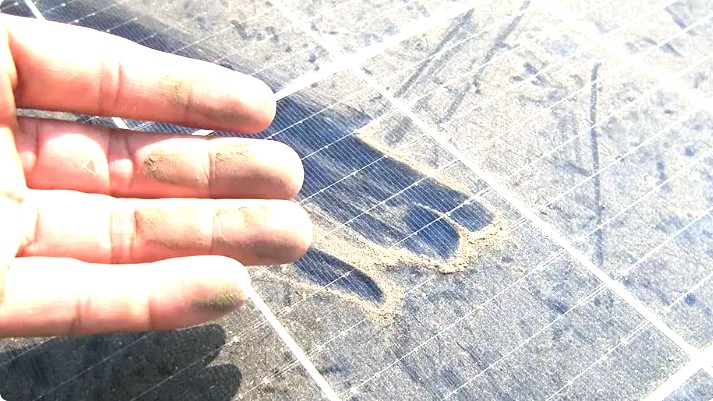
Fine agricultural and road dust settles between rain events and doesn't rinse off on its own. One finger drag is usually enough to show how much is up there.
Spot-free residential solar panel cleaning. Water-fed pole and deionized water only — no detergents, no pressure washers, no warranty risk.
 After we clean
Before
After we clean
Before
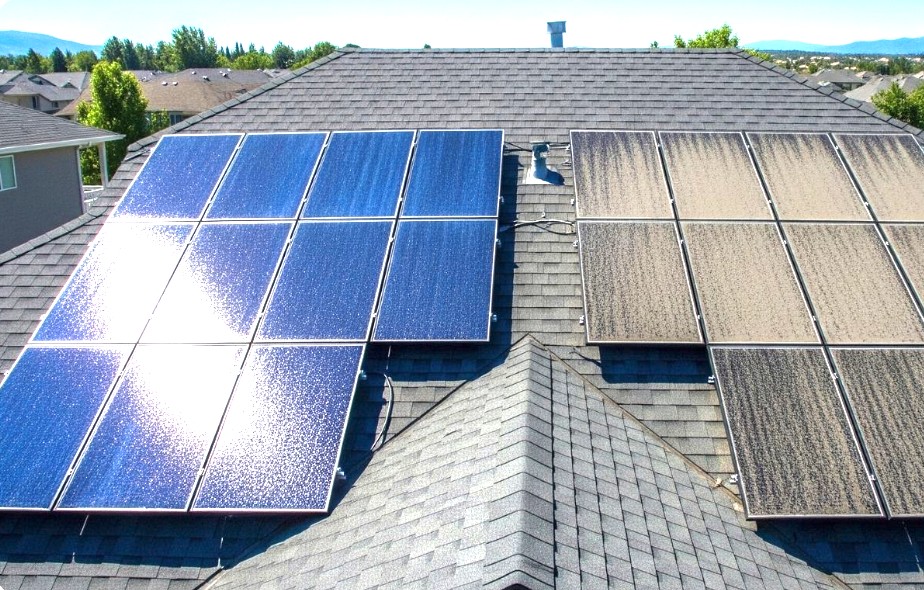
A real client roof — left: after we cleaned. Right: before.
California pays PG&E among the highest residential rates in the country — pushing ~48¢ per kWh as of 2026. Dirty panels quietly skim 14–20% off your production over a year. A cleaning recovers nearly all of it. Drop your ZIP and your panel count to see what your home would save.
Soiling and sun differ by neighborhood. Drop your ZIP and we'll calibrate the math to your microclimate.
A typical California home has 15–25 panels. A quick count from the driveway or sidewalk usually works.
A typical California residential solar install runs $18,000–$25,000. Skipping cleanings is the fastest way to shorten its life. Here's what peer-reviewed research says actually happens to dirty panels.
When part of a panel is dirty and the rest isn't, the shaded cells get reverse-biased and heat to 20°C above their neighbors. Peer-reviewed studies link this to permanent cell degradation, micro-cracks, and delamination of the panel's protective layers.
Bird droppings are acidic. Left on the panel, they pit the protective glass coating. Even after the dropping is washed away, the etching stays — and so does the lost output. The damage compounds the longer it sits.
Several major panel manufacturers require documented cleaning (every 6 months for some brands) before they'll honor a warranty claim. No paper trail of maintenance — no safety net when something fails.
Here's what actually goes wrong when nobody's washing them — and why a $300 service quietly protects a $20,000 asset.
Bird-dropping acid pits the glass. Hot spots from uneven dust burn cells from the inside. Neither heals. Every year you skip a cleaning, the permanent loss gets a little bigger — and a little more expensive to ever recover from.
Major panel manufacturers require documented cleaning — some every 6 months — before they'll honor a claim. No paper trail = no payout. The day a panel cracks or stops producing, the bill lands on you instead of the manufacturer.
Stack damaged cells, etched glass, and a voided warranty for a decade and a system designed for 25–30 years often needs panel replacements (or a full overhaul) much sooner. That's $18,000–$25,000 out of pocket — the cost of a new install all over again.
25 years of cleanings at $300/year = $7,500 total. One premature system replacement = $18,000–$25,000. Cleaning costs less than half of a single avoided replacement — and that's before counting the $700+ a year you're already saving in recovered electricity.
You're not buying a cleaning.
You're buying back a decade of system life.
Drag the handle — or tap anywhere on the image.
A thin film of dust, salt, or pollen can cut production by up to a quarter — silently, month after month.
Peer-reviewed research (Duke, IIT Gandhinagar) found cleaning a heavily soiled array can raise output by up to 50%.
Our DI system rinses to near-zero total dissolved solids, compared to 100–400 ppm in tap water. No spots. No scaling.
California is tough on solar. Dry summers cake panels in dust, ocean and bay air leave salt scale, and year-round birds cover them in droppings that bake onto the glass. Rain doesn't fix it.
Fine agricultural and road dust settles between rain events and doesn't rinse off on its own. One finger drag is usually enough to show how much is up there.
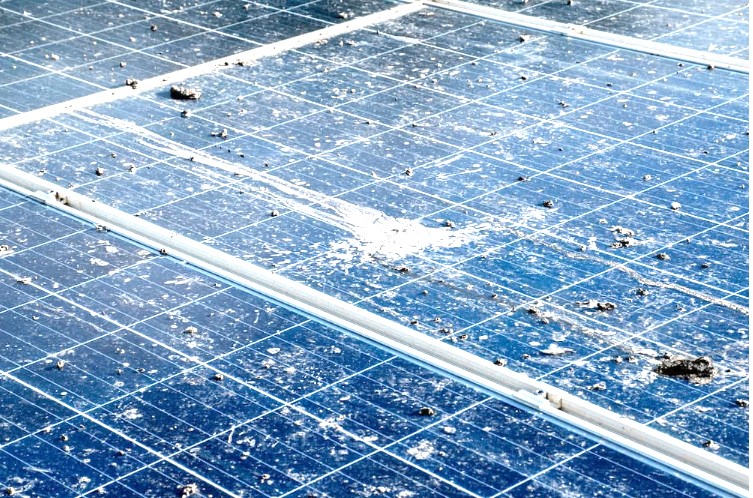
Bird droppings are acidic and bake onto hot glass. Even four drops on one panel can cut its output 12–33%. Hand-washing without the right method makes it worse.
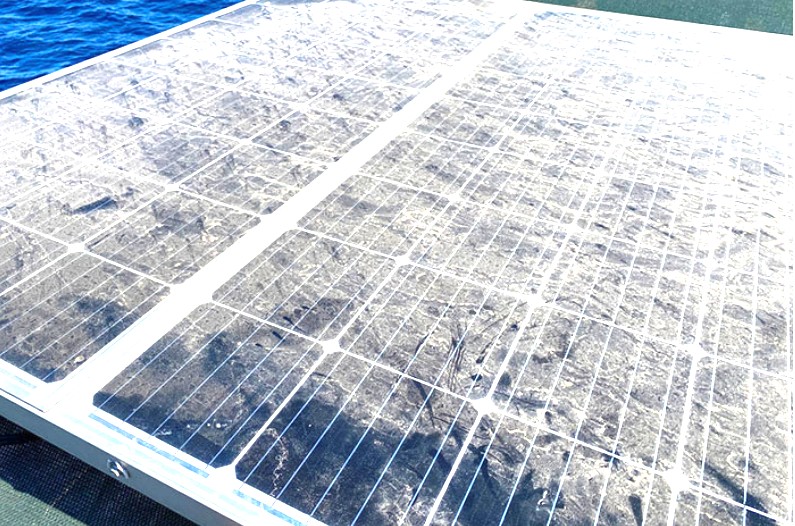
Anywhere near the coast or bay — Morro Bay, Half Moon Bay, Foster City, Pismo — salt and dissolved minerals leave a frosted film. Only deionized water pulls it off without leaving new spots behind.
The method your panel manufacturer recommends — and the one backed by the research on panel longevity.
Dial (408) 636-3014. We'll ask a few quick questions: how many panels, roof pitch, access, and whether you've ever had them cleaned. You'll know the price before we book.
We arrive on time with the DI filtration system, carbon-fiber pole, and soft-bristle brush head already prepped. We clean early morning or late afternoon so your panels never get thermal-shocked. You don't need to be home.
Your panels dry to a spot-free finish. You notice it in your monitoring app within days. We recommend a maintenance cadence based on your home's site — usually every 6 to 12 months.
Price depends on panel count, roof access, and how long it's been since the last clean. No surprises. No upsells.
We clean residential rooftop solar across all of San Luis Obispo County and across Silicon Valley + the SF Peninsula. Same rates, same DI-water method, same warranty-safe approach. If you're unsure whether you're in our area, call — we'll confirm in ten seconds.
Most homes benefit from a clean every 6 to 12 months. If you're near agriculture, dirt roads, heavy tree cover, the bay, or a coastal salt zone, lean toward six months. We'll recommend a cadence on the phone based on your home.
Regular tap water carries dissolved minerals — calcium, magnesium, silica — that get left behind as spots and slowly build into a limescale film that blocks light. DI water rinses to effectively zero residue, protecting panel transmittance over the long term.
No. DI water, soft bristles, and low flow pressure are what most panel manufacturers specifically call out as approved methods. The things that can void a warranty — abrasive pads, pressure washers, harsh detergents, walking across panels — are exactly what we avoid.
Not usually. We just need outdoor water access and a clear approach to the roof line. We'll handle access ourselves — whether that's from the ground with our pole or a ladder setup for trickier roofs. If you want to meet first, we're happy to schedule around you.
Bird droppings, hardened dust, sap, and salt crust are exactly what our brush-and-DI method is built for. Heavy cases get a longer wet-down to soften the stain before we brush. If something genuinely won't come off safely, we'll tell you — we don't damage your panels chasing it.
A typical home array runs 30 minutes to an hour start to finish. Bigger systems take a little longer — we'll give you a time window when you call.
We focus on residential homes only. That's how we keep the quality consistent and the scheduling flexible for homeowners.
You can, and it helps knock off loose dust — but a garden hose sprays the minerals in your tap water directly onto hot glass, which is how mineral spotting starts. If that's been your routine for a while, a proper DI-water clean will remove what's built up.
One call, a quick quote, and we're on the schedule. Most homes clean in under an hour. Ask anything — we'll tell you straight.
Residential service · SLO County · Silicon Valley · Free quotes by phone